
Building AI-SGAP: What We’ve Built, What’s Left Before Release, and Who It’s For
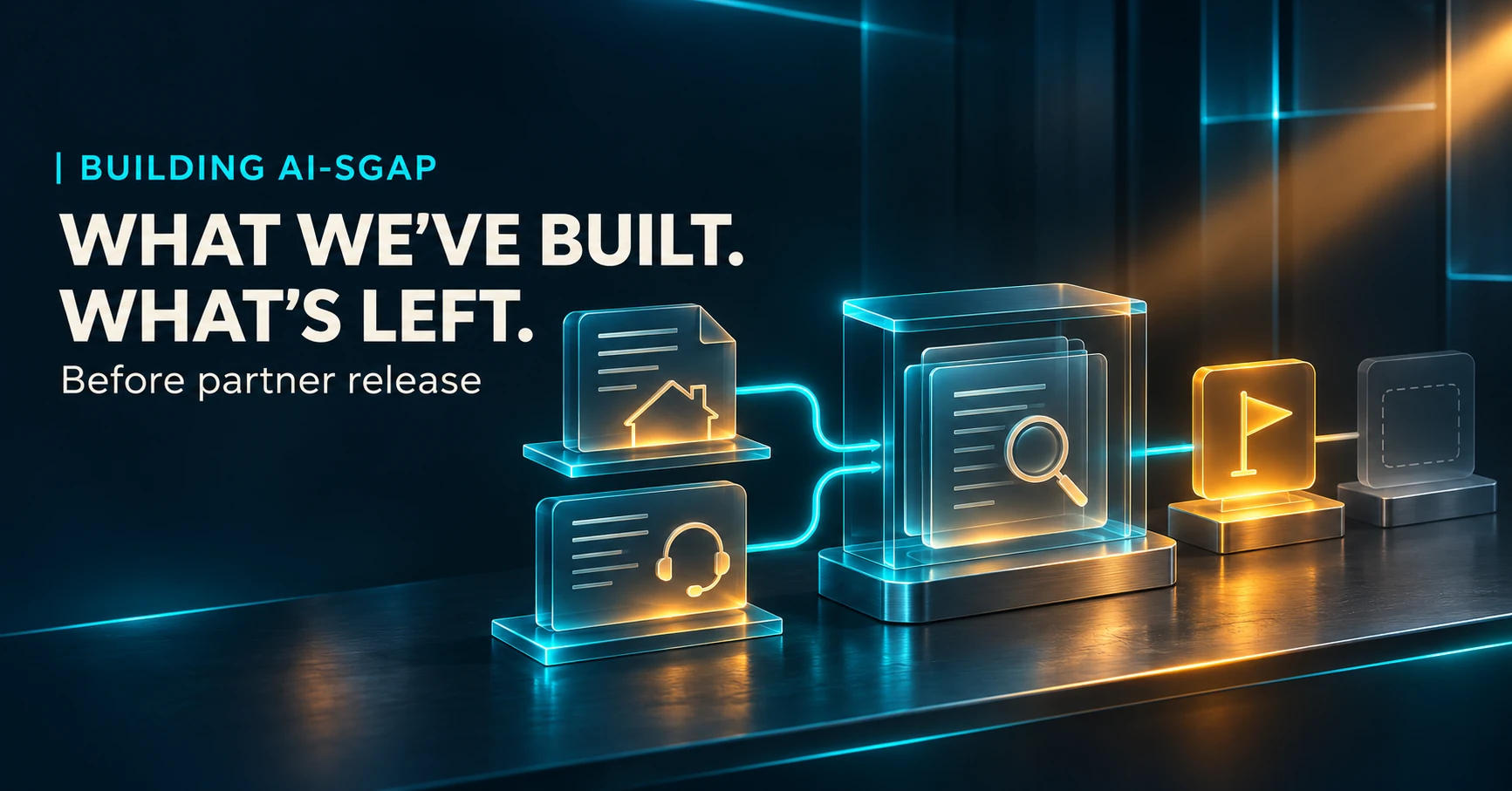
In the last edition, I wrote about the engineering beneath AI-SGAP: container validation, PostgreSQL integration, and why a model can quote the right source and still reach the wrong conclusion.
This time, I want to bring it back to the people who would use the product. When a team is deciding whether an AI agent can go live or take on more responsibility, what do they need to know? And what do I need to prove about AI-SGAP before asking that team to rely on it?
Those are two versions of the same question: What does the evidence support, and what decision can we make from it?
Where product development stands
AI-SGAP is the product I’m building to help organizations assess a specific AI system, identify where safeguards or evidence are missing, and prioritize what to do next.
- The core assessment workflow is executable. The internal baseline has 27 of 27 scoped build items complete. That baseline gives us something concrete to test and improve. Partner release is a separate milestone.
- Customer intake and assessor review have taken shape. We’ve worked on making it easier for a team to submit relevant evidence and understand why an assessor is asking for more. A useful follow-up should tell the team whether it needs to provide better evidence, fix a safeguard, or clarify what the system actually does.
- Model assistance is under evaluation. We’ve tested evidence interpretation with synthetic material. We can check whether a response follows a schema and quotes a source accurately. Whether that source supports the conclusion still needs review.
- Private AWS staging has demonstrated startup health at an earlier checkpoint. The November 25 review recorded no new deployment or executable acceptance. We still need to validate the assembled workflow in the hosted environment.
Use case 1: A bank deciding whether to pilot a mortgage document assistant
Imagine a bank wants to pilot an AI assistant that reads mortgage documents, identifies missing information, and drafts requests for follow-up. The pilot is supposed to keep a bank employee in control of anything sent to an applicant.
The security team receives a policy saying human review is required. The delivery team provides a diagram showing the review step. The release decision hinges on a more specific question: What evidence shows that this version of the assistant actually requires approval before a message goes out?
This is where AI-SGAP is intended to help. The assessment ties the question to the specific system and pilot scope, records what the submitted evidence establishes, and gives the team a specific next step. If the evidence only shows that a review screen exists, the next step could be to demonstrate that a message cannot be sent before approval.
For the bank, the benefit is a clearer basis for deciding whether to proceed with a limited pilot, narrow its scope, or wait for a safeguard to be verified. This is an illustrative scenario drawn from our synthetic mortgage work, rather than a customer result.
Use case 2: An enterprise expanding what a service desk agent can do
An internal service desk agent starts by answering questions from approved knowledge articles. The team now wants it to reset passwords or change group memberships.
The earlier assessment still contains useful evidence about the question-answering workflow. The proposed change introduces a different business decision: Under what conditions should this agent be allowed to change someone’s access?
AI-SGAP is designed to help the team document the change, identify which earlier evidence still applies, and focus the next review on the new permissions and safeguards. For example, the team could keep the agent’s existing answer-only scope while it gathers evidence that access changes require the right approvals and leave a usable audit trail.
That gives the service owner a way to discuss a narrower rollout, and it gives the security team a specific set of questions to resolve before the broader capability is enabled. This is an illustrative use case for reassessment, separate from any claim that automated change monitoring is ready to ship.
What I still need to prove before partner release
- The customer and assessor can complete the hosted workflow. That includes intake, evidence submission, clarification, and review under the intended roles, with tests showing that users are denied access outside their scope.
- The assessment remains useful when evidence is incomplete or conflicting. A partner needs to see what the assessment can support, where the uncertainty remains, and what action would resolve it.
- The environment can recover. We need an isolated restore that shows application records, evidence, and audit history can be recovered together, with measured recovery time and data loss.
- The release decision can be traced to the exact build. Historical evidence gaps still block full governance verification. The release package needs its own security review, operating boundaries, and explicit approval.
The next milestone I want to share is a controlled rehearsal that shows what a customer submits, what an assessor can conclude, and what happens when the evidence runs out. That will give prospective design partners something specific to evaluate: Does this help your team make a decision it would otherwise struggle to explain?
If you’re preparing to pilot an AI agent or expand what an existing one can do, I’d like to hear where your security review gets stuck. You can find the series and beta partner information at cloudgal42.com/ai-sgap/.
AI-SGAP is in development. Partner release has not been granted. The scenarios above illustrate intended use and do not represent customer outcomes or compliance certification.